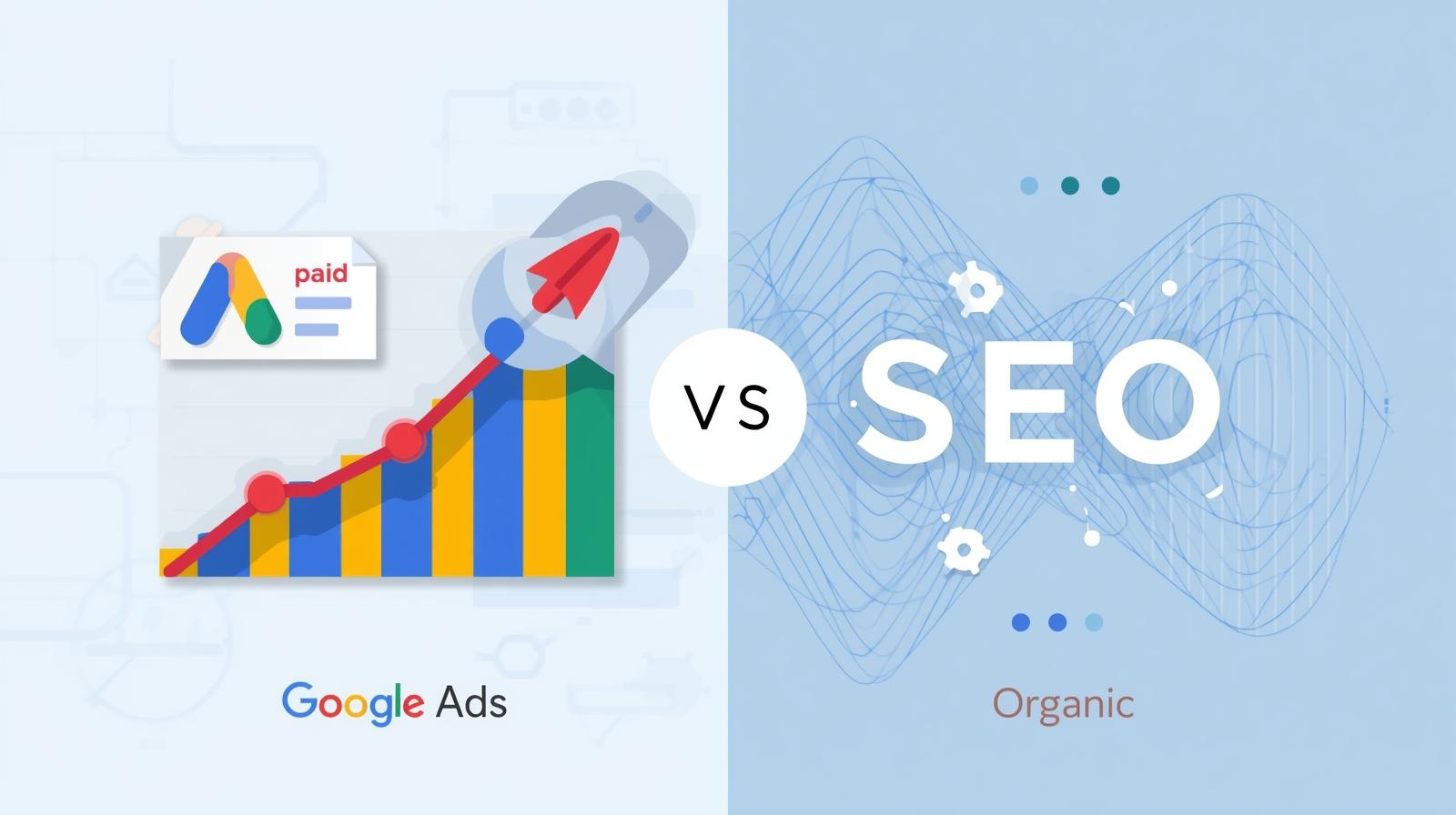
Google Ads vs. SEO: Which Is Right for Your Practice?
Understand the key differences between Google Ads and SEO to choose the best digital marketing strategy for your clinic.
You have inaugurated your clinic, the interiors are pristine, and your staff is ready. Now, you face the most critical challenge for any private practice in India: Patient Flow.
You have a marketing budget, perhaps ₹50,000 or ₹1 Lakh per month, and you are standing at a crossroads. Do you pour that money into Google Ads for immediate visibility, or do you invest in Search Engine Optimization (SEO) for long-term authority?
It is a dilemma we see constantly at DocScale. Statistics show that nearly 77% of patients now use search engines prior to booking an appointment. But how they find you—via a paid advertisement or an organic search result—impacts your budget, your brand perception, and your bottom line differently.
Choosing the wrong channel doesn't just waste money; it costs you valuable time in a market where competition from corporate hospitals and aggregators like Practo is fierce. Let’s break down the Google Ads vs SEO for doctors debate so you can make a data-driven decision for your practice (Updated for late 2025).
1. Speed vs. Sustainability: The Faucet and The Well
To understand the difference between PPC for clinics (Pay-Per-Click) and SEO, visualize your patient flow as water.
Google Ads is the Faucet. When you turn the tap on (pay Google), the water (patients) flows immediately. You can launch a campaign for "Laser Hair Removal in Delhi" at 9:00 AM, and by 2:00 PM, your phone might start ringing. This is ideal for new clinics that need cash flow now. However, the moment you stop paying, the tap runs dry. There is no residual value.
SEO is the Well. Digging a well takes manual labor, time, and patience. You might dig for months (optimizing content, building citations) without seeing water. But once you hit the source, you have a consistent, reliable supply of patients that doesn't cost you per bucket.
The Reality Check: For a newly established clinic in a Tier-1 city, relying solely on SEO is risky because it takes 4-6 months to mature. Relying solely on Ads is dangerous because costs inevitably rise.
Pro Tip: If you are launching a specific, time-sensitive offer (e.g., "50% off Dental Scaling for Diwali"), use Google Ads. If you are building your reputation as the "Best Orthopedic Surgeon in Pune," focus on SEO.
2. Cost Analysis: Renting vs. Owning Your Visibility
When discussing Healthcare marketing ROI, we must look at how you are spending your rupees.
The Cost of Google Ads (Renting): In Google Ads, you pay every time a patient clicks your link. In competitive Indian markets, a click for high-value keywords like "Invisalign cost Mumbai" can range from ₹80 to ₹250 per click. If 100 people click (Cost: ₹10,000) and only 5 book an appointment, your Patient Acquisition Cost (PAC) is ₹2,000 per patient. As more clinics bid on those keywords, that cost goes up. You are essentially renting space at the top of Google.
The Cost of SEO (Owning): SEO requires an upfront investment in content creation, technical optimization, and Google Business Profile management. However, once you rank #1 for "Pediatrician near me," you don't pay for the clicks. Whether 100 or 1,000 patients visit your site, the cost remains flat. Over 2-3 years, your acquisition cost drops significantly because your traffic is compounding while your investment stays stable.
Quick Win: Check your "Quality Score" in Google Ads. If your landing page is relevant and loads fast, Google charges you less per click. Never send ad traffic to your home page; send them to a specific service page.
3. The Trust Factor: "Sponsored" vs. Organic
Indian patients are becoming increasingly digitally savvy. They know what an advertisement looks like.
When a user searches for a serious condition—say, "Best Oncologist in Hyderabad"—they are in a research mindset. They are looking for authority, not a sales pitch.
- Ads are marked with a bold "Sponsored" tag. While they get clicks, some patients subconsciously associate them with "selling."
- Organic Results (Map Pack and Websites) imply that Google trusts this doctor. Ranking naturally signals competence and popularity.
Furthermore, organic rankings are often tied to Patient Reviews. A Google Map listing with 4.8 stars and 200 reviews is far more powerful than a paid ad with no social proof. Trust drives conversion, and SEO builds trust better than ads do.
Pro Tip: Use your Google Ads to test keywords. If you find that the keyword "Painless Root Canal" brings you high-quality patients via Ads, invest in writing a long-form blog post about that topic to rank for it organically.
4. The Hybrid Approach: The DocScale Strategy
The debate shouldn't be Google Ads vs SEO for doctors—it should be how to use both.
At DocScale, we recommend a phased "Hybrid Strategy" for most Indian clinics:
Phase 1 (Months 1-3): Aggressive Ads + SEO Foundation
- Action: Run Google Ads to generate immediate appointments and cash flow.
- Background: Simultanously claim your Google Business Profile, fix website speed, and start publishing local content.
Phase 2 (Months 4-9): Balancing the Scales
- Action: As your SEO rankings improve and organic traffic starts trickling in, slightly reduce your Ad spend or reallocate it to high-ticket procedures only.
- Focus: encourage happy patients to leave reviews to boost your Local SEO.
Phase 3 (Month 10+): SEO Dominance
- Action: Your organic traffic should now be your primary source of new patients.
- Maintenance: Keep Ads running only for retargeting (showing ads to people who visited your site but didn't book) or for specific seasonal campaigns.
This approach ensures you don't starve for patients in the beginning, but you aren't held hostage by ad budgets forever.
5. Navigating the Indian Digital Ecosystem
In India, you aren't just competing with other doctors; you are competing with aggregators.
Search for "Dermatologist in Bangalore" and you will likely see Practo, Lybrate, and Tata 1mg dominating the top spots. Beating them on generic keywords is difficult and expensive via Ads.
Local SEO is your weapon against the giants. Practo cannot physically be located in your neighborhood. You can. Google prioritizes the Local Map Pack (the 3 listings with maps) above organic links for location-based searches. By optimizing for Local SEO, you can bypass the aggregators and appear right at the top, for free.
Quick Win: Ensure your clinic provides a WhatsApp button on your mobile landing pages. Indian patients prefer chatting over WhatsApp to confirm availability before calling.
Internal Linking: Where to Guide Your Readers
Understanding the difference between paid and organic channels is step one. Step two is ensuring your website is ready to convert that traffic. If you are running ads for specific treatments, ensure you link your blog readers to the relevant pages.
- Interested in long-term growth? Check out our SEO Services for Clinics page.
- Need immediate patient footfall? Explore our Google Ads Management packages.
Conclusion
So, which is right for you?
If you need patients tomorrow and have the budget to pay for them, Google Ads is your answer. If you want to build a brand that dominates your locality for the next decade and lowers your costs over time, SEO is non-negotiable.
Ideally, a modern medical practice needs a smart mix of both. You shouldn't have to guess where your marketing budget is going. You need a strategy that turns clicks into consultations.
Ready to stop wasting money on ineffective marketing? At DocScale, we build custom patient acquisition engines for Indian doctors. We handle the technical complexities of Ads and SEO so you can focus on care.
Book Your Free Strategy Consultation with DocScale
Frequently Asked Questions (FAQ)
Q: What is a good monthly budget for Google Ads for a single-specialty clinic in India? A: For a single-specialty clinic in a Tier-1 city (e.g., Dental or Skin), a starting budget of ₹20,000 to ₹30,000 per month is recommended to gather enough data and see tangible results. In Tier-2 cities, you can start with ₹15,000.
Q: Can I stop doing SEO once I rank #1? A: No. SEO is like gym membership; you cannot stop once you get fit. Competitors are always trying to outrank you, and Google frequently updates its algorithms. Consistent content updates and review management are required to maintain your top spot.
Q: Which is better for high-ticket surgeries: Ads or SEO? A: Google Ads is often better for immediate high-ticket leads (like Bariatric surgery or IVF) because these keywords have high intent. However, because the decision-making process is long, these patients will heavily research your organic presence and reviews before committing. You need Ads to get found and SEO to build the trust required to close.
Q: Do Google Ads help my organic SEO rankings? A: Officially, no. Spending money on Ads does not directly pay for higher organic rankings. However, Ads drive traffic to your site, and if users engage well (stay long, browse pages), these positive user behavior signals can indirectly benefit your overall site authority.